

Razer Book 13 Review
Razer has long been known every bit a maker of gaming peripherals and loftier-end consumer laptops. Yet with the Razer Book 13, they are taking a stab at the lucrative business concern and productivity laptop marketplace. Traditionally dominated by Dell and HP, existence successful in this expanse requires convincing IT pros that your laptop will make their employees more productive. Permit's see how the Book 13 stacks upwardly.
Razer is calling the Volume 13 an "ultrabook productivity laptop," also earning Intel'due south EVO certification. That'south a continuation of the Project Athena initiative to assist standardize the ultrabook market. The requirements include an 11th-gen Intel CPU, Wi-Fi 6, 9+ hours of battery life, fast wake times, and Thunderbolt iv.
The specific build I'll exist checking out today retails for $1,600 and has these specs:
- Intel Cadre i7-1165G7 CPU (4C/8T)
- Intel Iris Xe integrated graphics
- thirteen.4" 1920x1200 touch on screen with a 16:x aspect ratio
- 16GB LPDDR4x, 256GB 1000.2 PCIe SSD
- 2x Thunderbolt 4 ports, Wi-Fi half dozen
- 55Wh battery
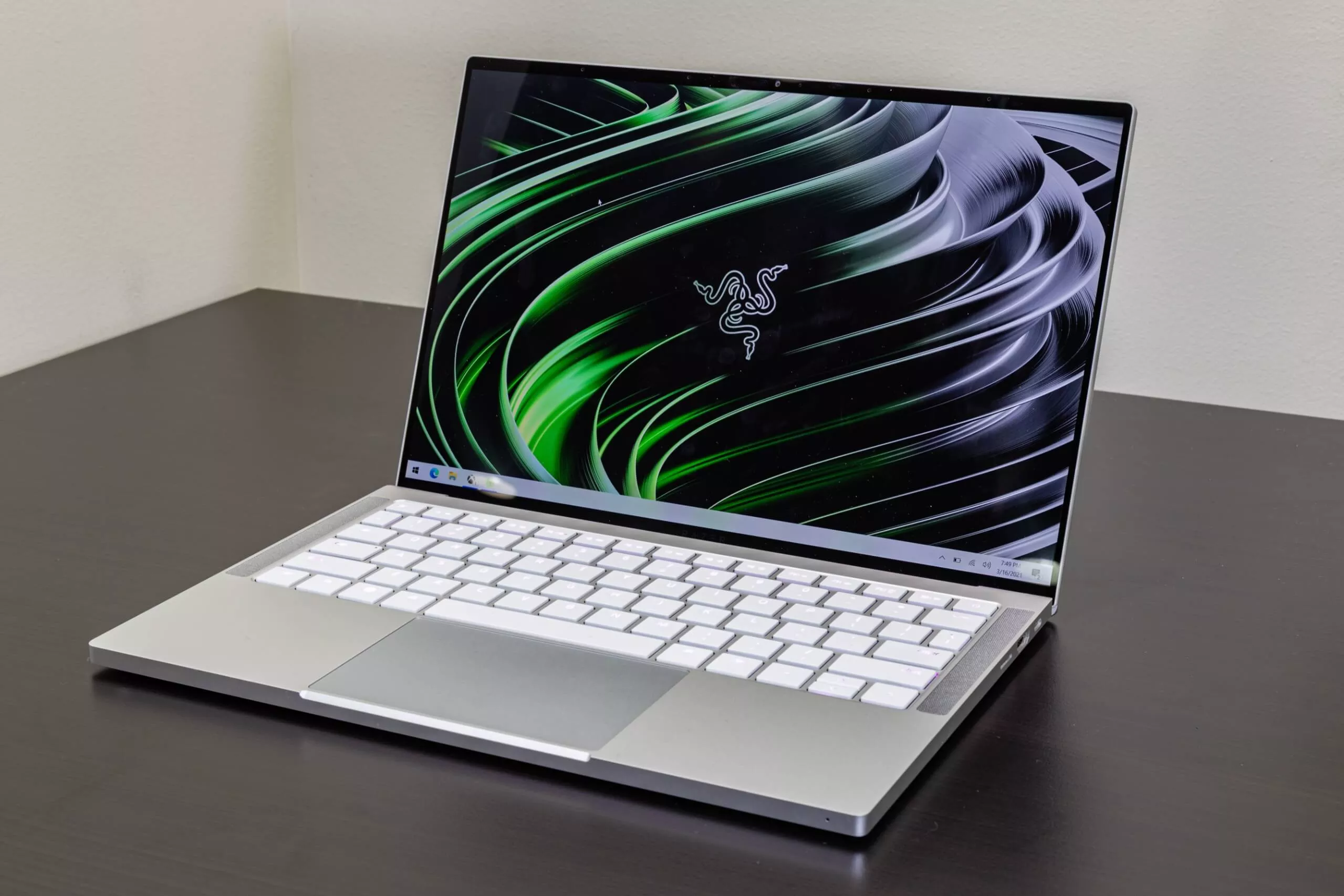
This configuration is Razer'south mid-range model in the series. Dropping downwards to the lower model, you'll get an i5-1135G7, a not-impact display, 8GB of RAM, and a toll indicate of $1,200. Moving upwardly to the higher model, you'll get a 3840x2400 UHD+ touch on screen, a 512GB SSD, and a cost bespeak of $two,000.
Build Quality and Cloth Design
With all the specs out of the way, let's take a await at the actual laptop. The shell is CNC'd aluminum which gives the Razer Book an extremely robust, premium feel. Notwithstanding, this too increases its weight compared to plastic or carbon fiber alternatives.
The Volume comes in at 3.1 pounds (ane.4Kg) which is about one-half a pound heavier than the Dell XPS xiii. I'll be honest, the very first affair I idea of when picking upwards the laptop out of the box is how dense it is. Yous do get some serious robustness for that extra half pound. For me, this tradeoff for superior build quality is worth the extra weight. For someone that carries their laptop around regularly though, information technology may be something you'll have to think about. In terms of size, the Book xiii measures 0.6" (15.15mm) tall, 11.six" (295.6mm) wide, and 7.viii" (198.5mm) deep.

The screen closes flush with the base on all sides giving it a slightly boxy look. It feels like there are some magnets effectually the edges to hold the screen downward when closed. This can help prevent damage if the laptop is in a pocketbook. It works well, but to me it was besides well. With such a small indentation at the forepart, the Book 13 is difficult to open up. In that location'due south but no way to become leverage in the front and information technology almost always takes two hands to pry information technology open. The alternative is to dig your fingernail into the modest groove in the front. This could be fixed by using a slightly less powerful magnet or making a larger finger cutout in the front.
The overall material blueprint is reminiscent of the older MacBook Pro style. The lighter colored ring around the border is a dainty bear upon to break the "solid chunk of aluminum" look. In terms of branding, there is a mirrorized Razer logo on superlative and that's it. Naught flashy. I call up it'southward a very subdued just pleasant wait. I could also see some finding information technology too bland though.
Connectivity is very proficient for a laptop in this category meaning yous'll be able to become by in many scenarios without a dongle. On the left side are a Thunderbolt 4 port, a USB iii.2 Blazon A port, and a 3.5mm combo port.

On the right side, we find some other Thunderbolt 4 port, a total-sized HDMI port, and a microSD menu slot. That total-sized HDMI port is really prissy and is often missing on laptops in this segment. It volition save you from walking into that important meeting without your dongle frantically trying to figure out how to bear witness your presentation.
Both Thunderbolt 4 ports support USB-C Power Delivery which gives you flexibility in how yous charge the laptop. At the top of the screen, you lot can see the 4-fashion microphone array and integrated 720p webcam with IR and Windows How-do-you-do back up. Microphone quality was really solid and sounded quite well-baked, albeit a tad compressed.
I was impressed with the webcam for the well-nigh office. It has bully color reproduction without an overprocessed wait. It would occasionally lose focus when there were multiple people in the screen though. Hopefully that's something that can be fixed in a futurity firmware update. If I'1000 being picky, it would exist nice to see the industry move to 1080p webcams given the rise in telework and video conferencing. There's no reason a $500 phone should have a better front facing camera than a $ane,500 laptop.

The bottom of the Book 13 has two rubberized pads to ensure proper airflow to the 2 cooling fans. The exhaust for the fans is correct below the screen hinge. The screen mesh that covers the fans is recessed and thin. If you happen to residuum the laptop on your knees or put pressure in that area when picking up the laptop, you may inadvertently contact the spinning fan housing. Not a fun audio to hear. I think using a thicker mesh or raising it slightly higher up the fan blades could have helped mitigate this. Thankfully, the fans don't come on much since the metal body of the laptop acts as ane big heatsink.

Internals and Performance
With the removal of ten Torx T5 screws, we're into the guts of the laptop. Immediately noticeable is that one-half of the space is taken up by the battery. That doesn't get out much room for user upgrades. In fact, the RAM is soldered to the PCB leaving the SSD equally the only upgradeable part. The mid-tier configuration of the Book 13, which I call back most people will gravitate to, comes with just a 256GB SSD. While near big files are stored on network shares in a business concern setting, I think 256GB is notwithstanding also small. I would have expected the mid-tier to come with 512GB and the summit-tier to come up with a 1TB drive.
The built-in SSD was a mixed bag in our testing. I measured cold boot times of 10.eight seconds. That's smashing, but it but tells half the story. While read functioning was good at ~2.7 GB/due south, we saw write functioning fluctuating between fast SSD speeds but then dipping into mechanical drive speeds at an embarrassing 90 MB/south rate in some tests.
When we looked up the bulldoze, it turns out our Book thirteen review unit of measurement came with a no-name bulldoze, while other reviewers report their laptops coming with Samsung drives. With the latest generation NVMe SSD pricing and then low, there are no valid excuses. We've reached out to Razer for clarification on this and will update the slice once nosotros hear back.

We've already reviewed the Intel Core i7-1165G7 (Tiger Lake) CPU that powers this laptop, and then nosotros won't spend as well much fourth dimension on performance benchmarks here.
In summary, information technology's one of Intel's ameliorate mobile CPUs, based on its latest mobile technology. Compared to Intel'southward previous tenth-gen chip, it's roughly 20% faster in multi-threaded performance and thirty% faster in single threaded scenarios. Compared to AMD's competing Ryzen 7 4800U, the i7 is better in single-threaded workloads while the Ryzen ordinarily gets the win in multi-threaded applications. For the type of workloads you'd likely exist doing on an ultraportable laptop like this, our review establish that Intel normally wins.
Also notable is the huge spring in graphics performance compared to previous Intel laptops. You'll exist able to get past fine on depression-to-medium settings at 1080p in many games.
If you need detached GPU power, Razer offers the Core X Thunderbolt three external GPU system. We'll exist checking that out presently so stay tuned for that review.
Since the laptop is basically a solid clamper of aluminum, it does tend to heat upward during heavy usage. The typing surface gets noticeably warm. That'south both a skilful thing and bad thing. If you're not a fan of warm laptops, you can adjust the cooling and performance settings in the pre-installed Razer Synapse. On the bright side though, this actress cooling helps to unleash the CPU from the thermal throttling that would otherwise hamper its performance on other laptops. The fans do become noticeable at full load, but they helped keep the sustained full-load temperatures below 75C in my testing.
With the talk of performance, equally important in a laptop like this is bombardment life. The 55Wh bombardment is decent, merely non record breaking. Of grade, battery life will depend on usage, just I measured just over 14 hours of idle screen-on time and about 9.75 hours of video playback. Information technology's hard to give numbers for typical usage since that depends completely on what you're doing, but you lot should expect a few hours less for more than agile piece of work. These tests were done with screen effulgence around 125 nits. While those are traditionally impressive numbers, there are enough of other laptops on the market with iii+ hours more bombardment life.

If you lot're just doing web browsing or reading/writing documents, you'll probably be fine making it through a full twenty-four hours. Anything more than intensive though and you'll want to charge up at some point.
With the included 65W USB-C charger, you're looking at about 1.5 hours to get a full charge from a drained bombardment. That works out to most 1% per minute or ane 60 minutes of life from a 10-15 minute accuse. In curt, you'll probably be fine for the day, simply if you absolutely need all-twenty-four hour period battery life, you may want to look elsewhere. Speaking of that charger, it's one of the smallest I've seen and the braided USB-C cable has a very premium feel.
Typing Surface and Touchpad
We'll put everything dorsum together and motion to the keyboard now. It's clear that Razer has a history of making keyboards considering this one has a very nice experience. The keys accept a firm initial resistance when you outset press downwards which results in a much more pronounced actuation than I was expecting. Not mushy at all.
The slight bump in overall thickness of the laptop allows for a much meliorate typing experience than other ultrabooks. The power button in the top right corner has extra resistance and an actuation delay to prevent inadvertent shutdowns. I recollect that's a dainty feature all laptops should have.

As you would expect on a Razer, the keyboard is fully RGB. The Synapse software allows you to customize the lighting on a per-primal basis. You tin also configure fundamental bindings, macros, and different profiles. Not super useful for a business/productivity laptop, but notwithstanding nice to take the choice. I was a bit disappointed with the backlight quality though, peculiarly on the wider keys.
The individual key markings are well-nigh completely transparent with little to no diffusion. This causes the lite to be concentrated at the center of the key and not illuminate the total width. While it's specially noticeable on the "Enter", "Caps", and "F4" keys, it's fine on nigh other keys. Adding a light diffuser or a second LED for these keys would have been squeamish. It'south not a huge bargain, merely but gives the Book 13 an uncharacteristically unpolished look for a Razer product.
Moving downward to the touchpad, I found it to be a solid performer. It'south most as big every bit you can expect for a laptop of this size with a smoothen finish. Multi-finger gestures, palm rejection, and tap-to-click all had no bug. I would say the clicking was a bit mushy and not equally tactile equally I would take liked, though it still gets the chore done.
Sound quality from the stereo speakers was really good. It gets enough loud with minimal distortion until you crank it all the way upwardly. Information technology'south slightly on the tinny side with a lack of clear bass presence, simply that's standard on thin laptops. Clarity and stereo imaging were quite pleasant. I'd give it an A- and annotation that it's better than many of the other laptops on the marketplace.
Display
Razer is using a Precipitous LQ134N1JW48 panel which is nice and vibrant to look at. As is often the case with displays though, this comes at the expense of color accurateness.
All display tests were done with an X-Rite i1Display Pro meter and Calman 2022 Ultimate software from Portrait. I measured a tiptop brightness of 390 nits on my unit later disabling all the bombardment saver features. In the standard performance/ability balance mode, you lot can expect almost 200 nits at full brightness.

Pre-Calibration performance of the Book 13 in Calman Studio from Portrait
The built-in color accuracy was disappointing for such a premium laptop. Granted this isn't marketed every bit a content creation laptop, but I still would accept expected a bit amend. Average DeltaE values of four.iv for color and 8.eight for grayscale are well above adequate limit for doing whatsoever color-accurate work.

Post-Scale performance of the Book 13 in Calman Studio from Portrait
Later running through Calman's computer monitor calibration, I was able to lower the DeltaE values to something more than respectable. For color, the brandish ended up 1.five for colour and 5.6 for grayscale.
If y'all don't necessarily care about color accuracy though, you'll love the display. It's bright, doesn't take much glare, and does a decent job of hiding fingerprints. It seems that Razer and Sharp have gone with a default colour contour that is designed to be visually highly-seasoned to the masses rather than colour accurate for the few that need it. I'm fine with that option.
It'due south a great screen. The slight jump to a 16:ten aspect ratio is a bonus and gives just a bit more real estate without making the laptop bulkier. Although Razer offers a UHD+ screen in the summit-tier configuration, I don't call back that's necessary. On a thirteen.4" screen, FHD (actually 1200p since it's a 16:ten brandish) is plenty dense and you'd hardly be able to notice the college resolution.
Who Is Information technology For?
To wrap it all up, I was quite impressed with the Razer Book thirteen. At $one,600 for the mid-range model I reviewed, information technology's not affordable, simply that'south not out of the ordinary for business/productivity laptops. It's on the mesomorphic side, although that added weight gives it keen build quality and sturdiness. While most other brands on the market have gone with a more than curved and tapered design, Razer is sticking with a rectangular approach and straight lines. This has the added do good of allowing full-size HDMI and USB Type-A ports, something not plant on many competing models.

Performance is superb. The i7-1165G7 does great work and the born graphics are solid every bit well. With the metal structure plus a slight increase in thickness and weight, Razer can allow the CPU run much faster than other laptops with the same CPU. The weak spot here is the SSD unfortunately. I'm quite disappointed that Razer didn't get with a higher quality, and larger drive. That said, if you're in the marketplace for a $1,600 laptop, an actress $150 for a existent One thousand.two NVMe SSD isn't going to suspension the bank. The keyboard, touchpad, and speakers are all great overall. Battery life is decent, but not as skilful every bit another laptops on the marketplace. The screen is bright and cute out of the box, although not very colour-accurate.
There are a lot of dandy laptops in this cost category and it can be very difficult to choose. Much of it comes downward to appearance and which one you can get a amend bargain on. I would say the main competitors for the Volume 13 at this cost indicate are the MacBook Pro M1, the HP ProBook 630 G8, the Lenovo ThinkPad X1 Carbon, and Dell's XPS 13. These are all outstanding laptops in their own rights, but permit's have a quick 2d and compare them.
With the MacBook, you can go a higher resolution screen and improved battery life for roughly the aforementioned cost. It'southward hard to direct compare performance between the i7 and M1 since the M1 is so new and uses a unlike ISA. The M1 wins handily in some tests and in others the i7 takes the block. Don't forget that you'll take to gene in the price of a dongle if you went that route.
Looking at the HP ProBook 630 G8, yous can crash-land upward to a 512GB SSD with an additional 32GB of Optane Memory, but the screen isn't virtually as nice and y'all don't get Thunderbolt ports. Lenovo's ThinkPad X1 Carbon configuration at this price range likewise bumps you up to a 512GB drive, keeps the Thunderbolt 4 ports, and sheds a few ounces. It does have more of a plastic construction though, then it won't feel as premium as the Book 13. Even so the ThinkPad is a good option if you adopt a more than traditional look. Finally, we have the XPS 13. It also has CNC'd aluminum structure, but has very limited port selection and its performance is hampered by a less robust cooling system.
Our concluding decision would come downward to this. If thinness and portability are large concerns for you, the Razer Book 13 might not be it. However, if y'all're fine sacrificing some of that for big functioning gains and solid build quality, you lot'll be very happy with the Book 13.
Shopping Shortcuts
- Razer Book 13 at Razer.com, Amazon
- Intel Core i7-1165G7 Tiger Lake Laptops on Amazon
- Intel Cadre i7-1185G7 Tiger Lake Laptops on Amazon

Source: https://www.techspot.com/review/2223-razer-book-13/
Posted by: longthate1938.blogspot.com
0 Response to "Razer Book 13 Review"
Post a Comment